,

검수 · Plans, pricing & data sizing
업데이트 2026-10-04
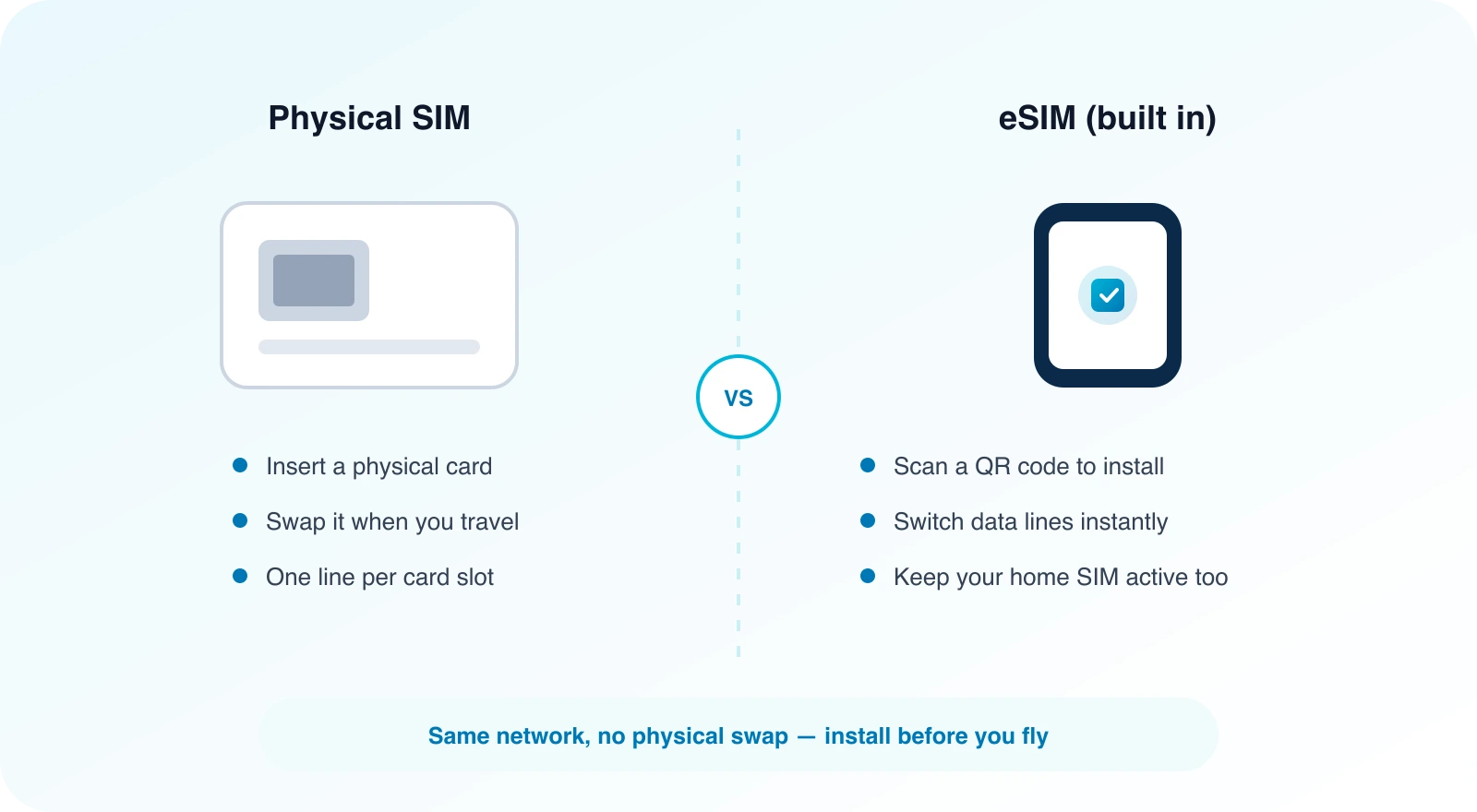
Download a plan instead of swapping a tray card at a kiosk.
Set it up at home on Wi‑Fi and land with data ready to go.
Run data on the eSIM while calls and SMS OTP stay on your primary line.
Change your preferred data line in Settings — no store visit required.
Pick a destination or regional data pack on the web.
Checkout issues a QR code and activation details to your dashboard.
Scan the QR before you fly — takes about two minutes.
Switch Cellular/Mobile Data to the travel line and you're online.
as literal ASCII text, with Korean content between them.
We need to translate title: "What Is an eSIM? A Clear Guide for Travelers". Korean: "eSIM이란? 여행자를 위한 명확한 가이드". Maybe "eSIM이란? 여행자를 위한 명쾌한 가이드". Keep within length.
Description: "Learn how embedded SIMs work, how travel eSIM data plans differ from plastic SIMs, and why travelers use them abroad." Korean: "내장형 SIM이 어떻게 작동하는지, 여행용 eSIM 데이터 플랜이 플라스틱 SIM과 어떻게 다른지, 그리고 여행자가 해외에서 사용하는 이유를 알아보세요." Must be max 160 characters. Let's count: Korean characters count? Let's approximate: "내장형 SIM이 어떻게 작동하는지, 여행용 eSIM 데이터 플랜이 플라스틱 SIM과 어떻게 다른지, 그리고 여행자가 해외에서 사용하는 이유를 알아보세요." That's about 70-80 characters, well under 160.
Now body: We need to translate all content, preserving headings, bullet lists, table, FAQ. Also need to include call to action and 1-2 links from allowed list. The article already includes links: Destinations, Physical SIM vs eSIM, compatibility check, eSIM vs roaming, Install on iPhone, Android, How much eSIM data do I need?, Destinations, FAQ. Also maybe other links.
We must ensure we only use allowed internal link paths. The allowed list includes many paths. We need to translate link text, but keep the path unchanged. For example, "Destinations" becomes "Destinations"? Actually we need to translate the link text (the part before slash). So Korean translation of "Destinations" is "목적지". So link becomes "목적지". Similarly, "Physical SIM vs eSIM" -> "플라스틱 SIM vs eSIM"? Actually "Physical SIM vs eSIM" translation: "플라스틱 SIM vs eSIM". Keep path same: "/guides/physical-sim-vs-esim". So link text becomes "플라스틱 SIM vs eSIM". For "compatibility check" -> "eSIM 호환성 확인". Path: "/guides/esim-compatibility-check". So link: "eSIM 호환성 확인". For "eSIM vs roaming" -> "eSIM vs 로밍". Path: "/guides/esim-vs-roaming". So link: "eSIM vs 로밍". For "Install on iPhone" -> "iPhone에 eSIM 설치". Path: "/guides/how-to-install-esim-iphone". So link: "iPhone에 eSIM 설치". For "Android" -> "Android에 eSIM 설치". Path: "/guides/how-to-install-esim-android". For "How much eSIM data do I need?" -> "필요한 eSIM 데이터 양은?" Path: "/guides/how-much-esim-data-do-i-need". For "Destinations" again -> "목적지". For "FAQ" -> "자주 묻는 질문". Path: "/faq". Also maybe other links like "tickets" but not needed.
We need to preserve structure: headings: "## eSIM in one minute". Korean: "## eSIM 1분 만에 이해하기". Or "## eSIM 1분 만에". Let's keep similar: "## eSIM 1분 만에". But maybe "## eSIM 1분 만에". We'll translate.
Bullet list items: need Korean translation.
Travel eSIMs are usually data-focused. You keep your home number on the primary SIM for calls and SMS while browsing on the eSIM. -> "여행용 eSIM은 주로 데이터 전용입니다. 기본 SIM(집 전화번호)으로 통화와 문자 메시지를 유지하면서 eSIM으로 웹 서핑을 합니다."
How travel eSIMs work: steps.
You buy a destination or regional pack on the web (Destinations). -> "1. 웹(목적지)에서 목적지 또는 지역 패키지를 구매합니다."
The provider issues a QR / activation code tied to that plan. -> "2. 제공업체는 해당 플랜과 연결된 QR 코드/활성화 코드를 발급합니다."
Your phone downloads the profile over Wi‑Fi. -> "3. Wi‑Fi를 통해 폰이 프로필을 다운로드합니다."
At the destination, the eSIM attaches to a partner network included in the plan. -> "4. 도착지에 도착하면 eSIM이 플랜에 포함된 파트너 네트워크에 연결됩니다."
PingRoam follows this model: web purchase, QR in the dashboard, companion app for viewing — no in-app plan sales. -> "PingRoam은 이 모델을 따릅니다: 웹 구매, 대시보드에 QR 코드, 동반 앱으로 보기 — 앱 내 판매는 없습니다."
eSIM vs physical SIM (short) table.
We need to translate table headers and content.
| eSIM | Physical SIM | |
|---|---|---|
| Form | Digital profile | Plastic nano-SIM |
| Swap | Instant download | Tray tool + card |
| Dual use | Often + physical SIM | One tray (unless Dual SIM hardware) |
| Best for travel | Pre-install before landing | Local kiosk after arrival |
Translate:
| eSIM | 플라스틱 SIM | |
|---|---|---|
| 형태 | 디지털 프로필 | 플라스틱 나노 SIM |
| 교체 | 즉시 다운로드 | 트레이 도구 + 카드 |
| 듀얼 사용 | 종종 물리 SIM + eSIM | 한 트레이 (듀얼 SIM 하드웨어가 아닌 한) |
| 여행에 최적 | 도착 전 미리 설치 | 도착 후에 현지 키오스크 |
But need to keep same column alignment. Use Korean terms.
Better to keep English terms in the table? The instruction says translate content, but keep internal links unchanged. For table, we can translate the content but keep the column headers maybe same? The original table had "eSIM" and "Physical SIM". We can translate those as "eSIM" and "플라스틱 SIM". Keep the rest.
Now "Who can use an eSIM?" heading: "## Who can use an eSIM?" -> "## eSIM을 사용할 수 있는 사람은?" Or "## eSIM을 사용할 수 있는 사람은?" Let's translate: "## eSIM을 사용할 수 있는 사람은?" (question). Or "## eSIM을 사용할 수 있는 사람". We'll choose "## eSIM을 사용할 수 있는 사람은?" but maybe better "## eSIM을 사용할 수 있는 사람". We'll keep as "## eSIM을 사용할 수 있는 사람". But the original is a question, but we can translate as statement.
Examples commonly include recent iPhone, Google Pixel, and Samsung Galaxy flagships — always verify your exact model. Use the compatibility check. -> "예시로는 최신 iPhone, Google Pixel, Samsung Galaxy 플래그십이 있습니다 — 정확한 모델을 확인하세요. eSIM 호환성 확인."
Benefits for travelers:
Limits to know:
FAQ:
Now Next steps:
Install on iPhone or Android -> "iPhone에 eSIM 설치 또는 Android에 eSIM 설치"
Size your pack: How much eSIM data do I need? -> "필요한 eSIM 데이터 양은?"
Browse Destinations · FAQ -> "목적지 · 자주 묻는 질문"
We need to ensure total word count 900-1400 Korean words. Let's approximate. The English article is about 800 words maybe. Korean translation will be longer due to language. Need to keep within 900-1400. We'll aim for about 1100 Korean words.
We must ensure we keep the three markers exactly as ###TITLE###, ###DESC###,
