A family-paced Dubrovnik plan: city walls with kids, Lokrum peacocks, Gradac park picnics, aquarium backup and online maps on a Europe eSIM.
حدّث في 2026-11-22
Dubrovnik rewards slow travelers, and that goes double for families. The old town is car-free, small enough that nearly everything sits within a ten or fifteen minute walk, and the Adriatic is never more than a few steps from a sight. Kids here can swim between attractions, count peacocks on a protected island, and play in a park with fortress views. The trick is pacing. Here's a plan that keeps the walls, Lokrum Island and the green spaces in rotation without meltdowns.
Most of what you came to see sits inside the medieval walls, and there are no cars to dodge inside them. Swim spots are literally at the base of the ramparts, so a hot sightseeing hour can be traded for a dip without a bus ride. Add a fifteen minute ferry to a car-free island and a cable car to a hilltop, and you get variety most city breaks can't match.
The one honest caveat: July and August are hot and thick with cruise-ship crowds. Anchor your mornings to the big sights, keep afternoons loose for water and shade, and everything below falls into place.
The full circuit of the Walls of Dubrovnik runs about two kilometres. Fit adults do it in ninety minutes; with children, budget two to three hours and treat it as the day's main event, not a warm-up.
Two entrances matter to families: the main one near Pile Gate (locals say "PEE-leh") and a second on the harbor side by St John's Fortress. Starting at Pile in the first hour of the day buys you cooler stone and thinner crowds. Fill everyone's bottles at Great Onofrio's Fountain just inside the gate before you go up.
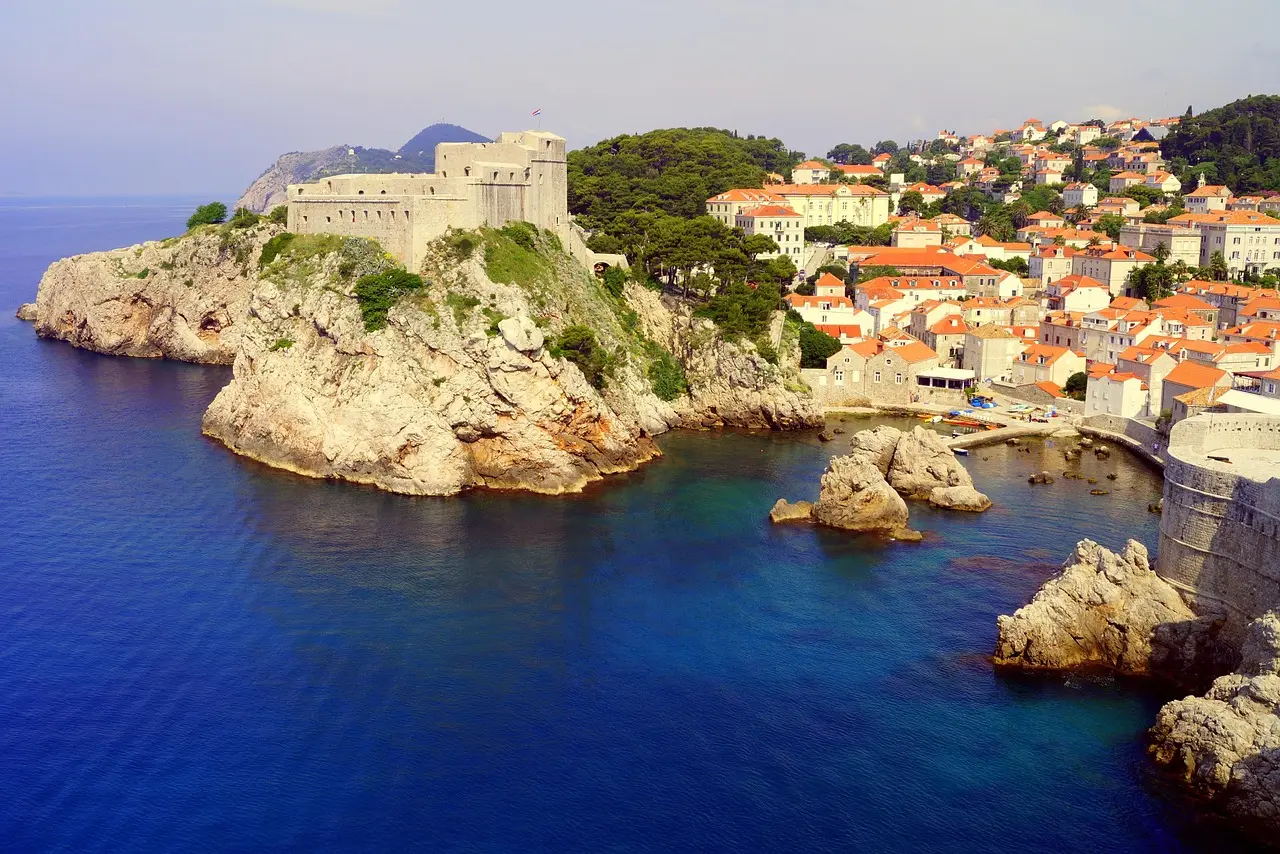
A few practicalities. The route is mostly stairs, so strollers are out; a baby carrier is the way to go for toddlers. In peak season the walk runs one way, and there's no easy exit halfway, so commit before you climb. Shade is scarce, so hats and sunscreen are non-negotiable. Rest points crop up in the shadow of the towers, and the climb to Minceta Tower at the northern high point is the stretch where kids start counting steps out loud. Save the reward talk: from Bokar bastion at the sea end, the views over Fort Lovrijenac and Lokrum do the motivating for you.
Your ticket covers one circuit, so don't plan to pop down for lunch and re-enter. If the walls feel like too much for your youngest, an alternative view waits through the doorway in the south wall near the cliffside Buža café, where you can sit with a drink above the water instead.
St John's Fortress guards the old harbor, and its ground floor holds the Dubrovnik Aquarium: dark, cool rooms of tanks with groupers, eels and other Adriatic sea life. It's compact by big-city aquarium standards, which is exactly the point. You can see everything in under an hour, making it the perfect backup for a scorching afternoon or a surprise rain shower.
One floor up, the Maritime Museum covers Dubrovnik's seafaring past with ship models, old charts and navigation instruments. Model boats tend to hold kids longer than paintings, and it pairs naturally with the aquarium under the same roof.
Ten minutes northwest of Pile Gate, Park Gradac sits on a bluff above a small bay, directly facing Fort Lovrijenac. There's a playground, plenty of pine shade, benches and locals rather than tour groups. Bring picnic supplies and let the kids burn off energy while you look at the walls from the outside, which is half the pleasure of Dubrovnik.
Closer to town, the Pile area just outside the gate has a small green strip, rocks where children swim and watch kayakers paddle past, and the main bus stop if you're staying farther out.
For a bigger payoff, ride the cable car up Mount Srd from the Ploče end of town. The gondola ride itself is the event for most kids, and up top you can walk around Fort Imperial, with the Museum of the Croatian War of Independence inside, and take in the full panorama of the red roofs and the Elafiti islands. It's a hill-above-the-old-town experience in the same spirit as Arthur's Seat above Edinburgh, just with a lift instead of a hike.
Lokrum Island floats fifteen minutes offshore by boat from the old harbor, with crossings roughly every half hour at busy times. The island is a protected nature reserve with its own entrance ticket, and it has no cars, no hotels and, thanks to an old curse legend, no overnight guests. Boats enforce that last part regardless.
What sells it for families: peacocks and rabbits wander freely (admire, don't feed), the ruins of the Benedictine monastery have enough nooks for a game of hide and seek, and the small botanical garden beside it dates to the 19th century and offers genuine shade on a hot day.
The salt lake on the island's southern side, called Mrtvo More, is the best swim for nervous parents in Dubrovnik. It's shallow, warm and wave-free, with no boats allowed. Swimming elsewhere on Lokrum means rocks and some sea urchins, so pack water shoes. Bring more water and snacks than you think you need, since options on the island are limited.
For the ambitious, a short uphill path leads to Fort Royal, a Napoleonic-era fort at the summit with views back over Dubrovnik and out to open sea. Check the return boat times posted at the jetty when you land, since the last boats leave well before dark in season. It's the same old-town-plus-island-boat formula that works beautifully in Stockholm's archipelago, just warmer.
Tap water from Great Onofrio's Fountain is drinkable and free, so refill there rather than buying bottles all day. Bakeries tucked into the lanes just off the Stradun sell doughnuts and burek that cost less than anything on the main drag, and ice cream shops everywhere make excellent bribery currency.
Shade is a strategy: the side alleys running off the Stradun stay cooler than the polished limestone main street, which turns into a griddle at midday and gets slippery after rain. For a free wind-down, walk the Porporela breakwater at the old harbor, where kids can watch ferries, kayaks and the occasional mega-yacht jostle for space.
Dubrovnik's old town is a maze of similar-looking lanes, and the signs to the walls entrance are easy to miss on your first pass. Live maps, the day's boat schedule for Lokrum, bus times back to your apartment and up-to-date opening hours from official sites all run on data, and a Europe eSIM covers Croatia along with the neighbouring countries most families tack on to the same trip. Our Europe eSIM guide runs through how regional plans work.
Two tips worth acting on. First, keep your home SIM active alongside the eSIM so bank verification texts still arrive; our dual SIM and eSIM travel tips explain the setup. Second, if you're unsure how much data a maps-and-messaging trip actually burns, the answer is less than you fear: see how much eSIM data you need. Install the eSIM before you fly so you land connected and skip the airport WiFi scrum.
The loop is about two kilometres. Adults finish in roughly ninety minutes, but with kids, plan on two
